


News
Round Table “Financial and Economic Professions of Uzbekistan: World-Class Standards for the National Labor Market”
20-04-2026 | 745
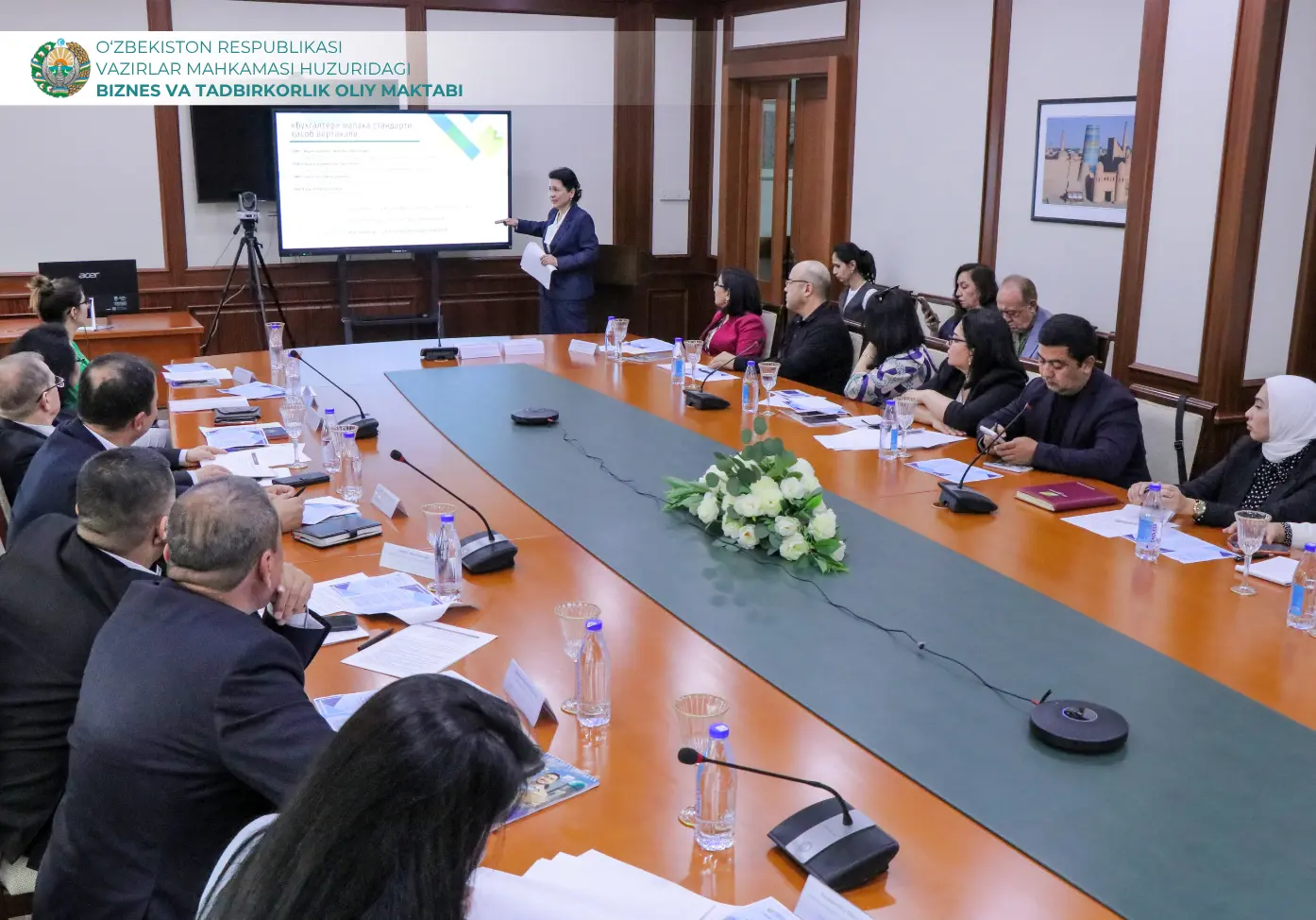
On April 16, 2026, the Graduate School of Business and Entrepreneurship under the Cabinet of Ministers of the Republic of Uzbekistan hosted a round table dedicated to the discussion of draft professional standards for “Accountant” and “Financial Manager.” The event brought together representatives of the Ministry of Economy and Finance, the Institute for the Development of the National Qualifications System, professional associations (ACFP, O‘zBAMA), as well as business and educational organizations.
The discussion was held in the context of implementing Presidential Decree No. 345 dated September 30, 2024, and the transition to International Financial Reporting Standards (IFRS).

Implementation of IFRS: Timeline and Requirements
Otabek Barakaev, PhD, Head of Department at the Ministry of Economy and Finance, presented the timeline for IFRS implementation in Uzbekistan and the requirements for public-interest entities to transition to new reporting standards. He emphasized that the transition to IFRS requires fundamentally new competencies from financial professionals, which should be reflected in the new professional standards.
The Role of Employers in Ensuring the Quality of Professional Standards
Jakhongir Parmanov, Senior Specialist at the Institute for the Development of the National Qualifications System, explained the mechanism of interaction between the labor market and the education system through the national qualifications framework. Employers are shifting from passive consumers of personnel to active customers, participating in planning, implementation, and evaluation of educational programs through the development of professional standards.

Labor Market Imbalances
Dilfuza Kurbanova, PhD in Economics and Deputy Head of the Project Office “Promotion and Implementation of Green Economy,” presented an analytical report by the Graduate School and ACFP on the labor market for finance professionals. The analysis of seven years of data revealed a significant imbalance: despite a large number of resumes, there is a serious shortage of qualified specialists in accounting and financial management.

Concept of a New Qualifications System
Shokhista Yakubova, Chair of the ACFP Qualifications Committee, presented the concept of a new system of professional standards for financial and economic specialists. She justified the need to split the universal “Accountant” standard into two separate tracks: accounting (accountant) and financial management (financial manager), highlighting fundamental differences in functions, responsibilities, and planning horizons.
Transition to Market Requirements
Mikhail Perper, Chairman of ACFP, explained the differences between the new and existing professional standards. The key shift is the transition from departmental instructions to open market requirements, where international standards, digital competencies, and professional certifications are highly valued.

Professional Vertical: From Assistant to Chief Accountant
Proposals from the National Association of Accountants and Auditors of Uzbekistan
Dilora Saidamanova, Chair of the Education and Certification Committee of NAAA Uzbekistan, highlighted the strengths of the draft standards: a clear vertical structure from levels 4 to 7 of the National Qualifications Framework, inclusion of IFRS and ESG reporting, alignment with IFAC ethics code, and partial qualification mechanisms. She proposed expanding IFRS competencies, including CAP/CIPA certifications as additional qualification criteria, and introducing mandatory continuous professional development.

Rufina Mirsharipova, Chief Accountant at “Credit Asia,” presented a four-level matrix of the “Accountant” standard (levels 4–7 NQF), defining a professional hierarchy from assistant accountant to chief accountant of a large company, clearly distinguishing job functions, skills, knowledge, independence, and responsibility at each level.
Financial Manager: From Analyst to CFO
Natalya Turalinova, Director of Arkad Audit, presented the content of the “Financial Manager” standard (levels 5–8 NQF). The four qualification levels define requirements for specialists ranging from financial analyst to Chief Financial Officer (CFO) of a socially significant organization.

Proposals from the Samarkand Institute of Economics and Service
Samiddin Toshnazarov, Professor at SaIES, noted the high quality of the drafts and their compliance with international standards. He proposed expanding their content by adding functions related to intangible and biological assets accounting, extending IFRS coverage at level 7, and improving competencies in auditing, taxation, IT, and financial law.

Recommendations of Round Table Participants:
- Support the transition from a single standard to two separate ones: “Accountant” (levels 4–7 NQF) and “Financial Manager” (levels 5–8 NQF)
- Recognize the separation of roles: accountants ensure the reliability of financial information, while financial managers ensure efficient resource utilization
- Introduce partial qualification mechanisms (e.g., accounting cashier, treasury specialist) for step-by-step career development
- Update the National Classification of Occupations (NCO-2025) by adding positions that actually exist in the labor market
- Organize broad expert and public discussions of the draft standards
- Conduct awareness activities for employers on the application of professional standards in hiring, evaluation, and career planning
- Refine the draft standards based on practitioner feedback and initiate official approval procedures
Update state educational standards and university curricula after the approval of professional standards

Next Steps
The draft professional standards will be revised considering the comments and proposals of round table participants and published for public discussion.
