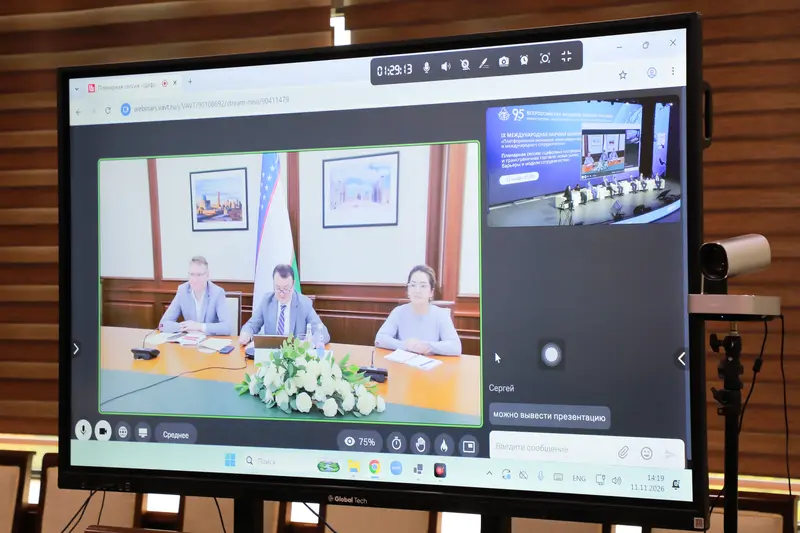



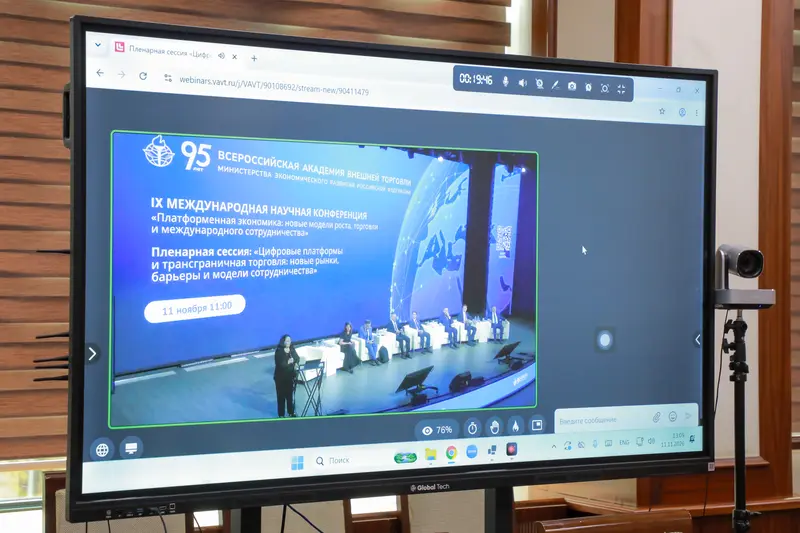
From 10 to 13 November 2026, the IX International Scientific Conference “Platform Economy: New Models of Growth, Trade and International Cooperation” is being held at the Russian Foreign Trade Academy under the Ministry of Economic Development of the Russian Federation.
The conference focuses on the development of the platform economy, the digital transformation of international trade, and new opportunities for cross-border electronic interaction.
The event brings together representatives of the business community, Russian research and educational institutions, as well as international scholars and experts in the fields of international economics, trade and digital development.
The Graduate School of Business and Entrepreneurship was represented at the conference by its Deputy Director, who delivered a presentation entitled “Digital Trade Platforms and the Role of Business Education” during the plenary session.
His presentation focused on the development of e-commerce in Uzbekistan, which has experienced rapid growth over the past five years, increasing from USD 99.5 million in 2020 to USD 1.8 billion in 2025. Its share of total retail trade reached 4.6%, while the number of self-employed individuals engaged in this sector exceeded 515,000.
This growth has been driven by three main factors: the expansion of internet access and mobile payment services; the entry of major international platforms alongside national marketplaces; and government support measures for entrepreneurs. In particular, the conditions for cross-border trade are being improved, while bonded warehouses and customs infrastructure are being developed. By 2030, the country has set a target of increasing e-commerce turnover to USD 2.4 billion and attracting USD 300 million in investment.
At the same time, certain barriers remain, including challenges related to cross-border trade, differences in certification and labelling requirements, and a shortage of modern warehousing facilities. However, one of the main constraints continues to be the limited level of e-commerce skills among manufacturers and exporters.
In this regard, the Graduate School of Business and Entrepreneurship is taking active steps to develop digital business education and train specialists in this field. In particular, in cooperation with Ajou University (South Korea), the School implements the MBA in IT Business and MBA in Digital Economy programmes.

The Graduate School of Business and Entrepreneurship also places considerable emphasis on providing entrepreneurs in the country's regions with practical e-commerce training. In particular, in cooperation with the Wildberries marketplace, free short-term training courses are being conducted for representatives of small businesses, artisans, self-employed individuals, young people and women.
Participants acquire practical skills in key areas of online commerce, including product preparation, product listing creation, pricing, advertising and rating management, order processing and delivery.
The Graduate School of Business and Entrepreneurship intends to continue organising practical training courses for exporters, establish a training laboratory for cross-border e-commerce, expand regional accelerators and develop a network of local trainers.
At the same time, the training programmes will cover various digital platforms, enabling entrepreneurs to acquire versatile skills applicable across different online marketplaces.