


News
The Erasmus+ International Forum was held in Samarkand
29-09-2026 | 43
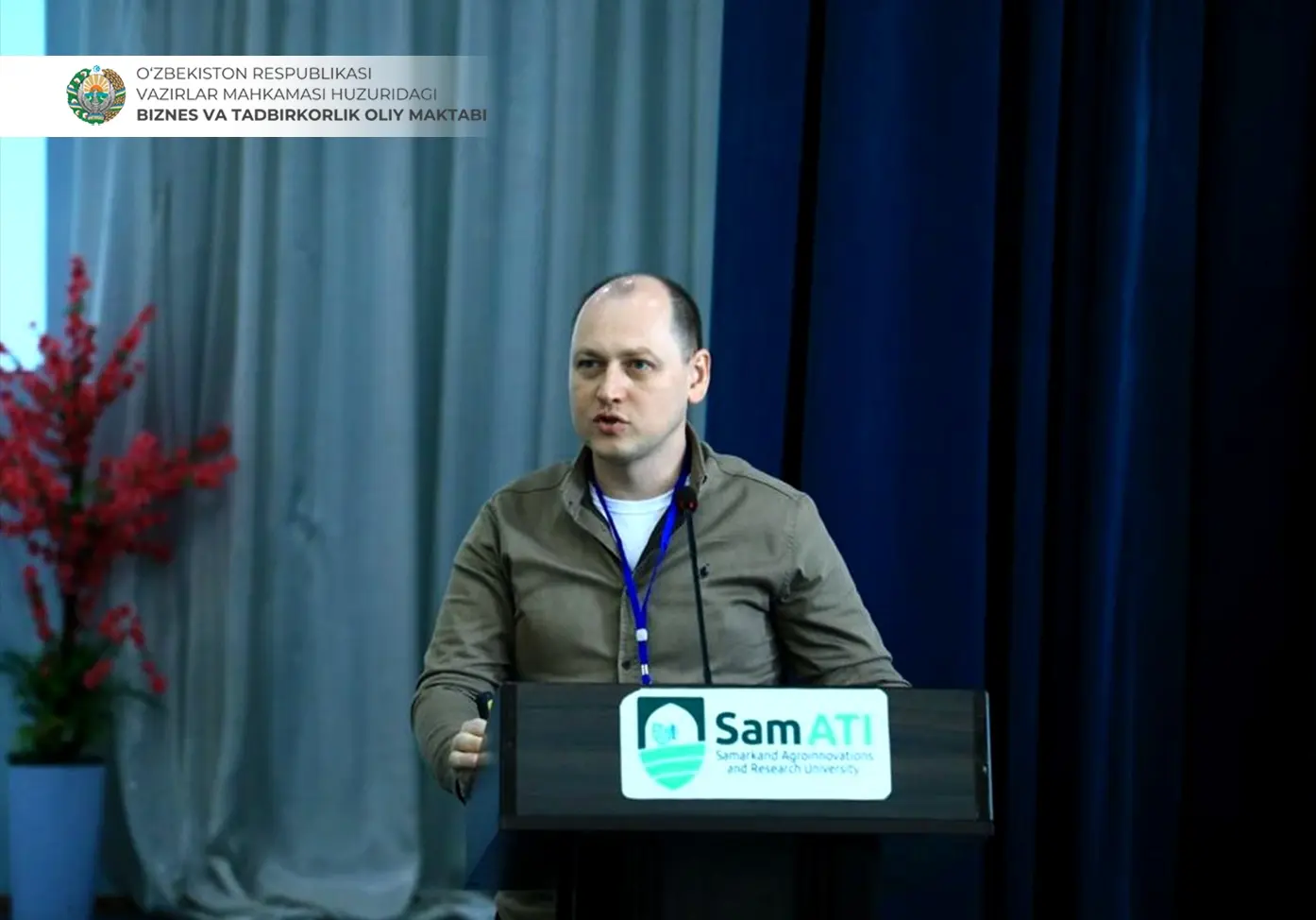
On September 25–26, 2026, Samarkand Agro-Innovation and Research University hosted the international forum “Innovative Forms of Education for Economic Growth and Human Capital Development.” The forum was organized as part of the OFINU project under the European Union’s Erasmus+ programme. It brought together representatives of government institutions, universities and businesses from EU countries, Uzbekistan and Tajikistan.
The plenary session opened with a presentation by Anton Kostyuchenko, Chief Specialist at the Project Office for the Promotion and Implementation of the Green Economy at the Graduate School of Business and Entrepreneurship under the Cabinet of Ministers of the Republic of Uzbekistan. His presentation was titled “The Role and Impact of Higher and Lifelong Education in Achieving National Economic Goals: The Central Asian Experience.”

The speaker examined lifelong learning policies in Uzbekistan, Tajikistan and Kazakhstan through eight dimensions of educational openness, including openness in terms of age, access, location, time, and recognition of qualifications.
Particular attention was given to the Graduate School of Business and Entrepreneurship (GSBE) as an institution that brings together five of these dimensions. Public sector employees retain their positions and average salaries during their studies. The Pre-MBA programme does not require a specific educational background or prior work experience. A structured educational pathway has been established, extending from regional training courses to MBA and dual-degree programmes. Approximately 30,000 people from Uzbekistan’s regions, including 9,547 women and 7,418 self-employed individuals, have received training through the qasbiy-talim.uz platform.

“This is what a lifelong learning university looks like in practice: a complete pathway for adults to return to education, brought together in one place,” Anton Kostyuchenko emphasized.
In closing, the speaker proposed establishing a national consortium for open education. According to him, the consortium would enable short courses and micro-credentials to be recognized and credited toward formal degree programmes.
